
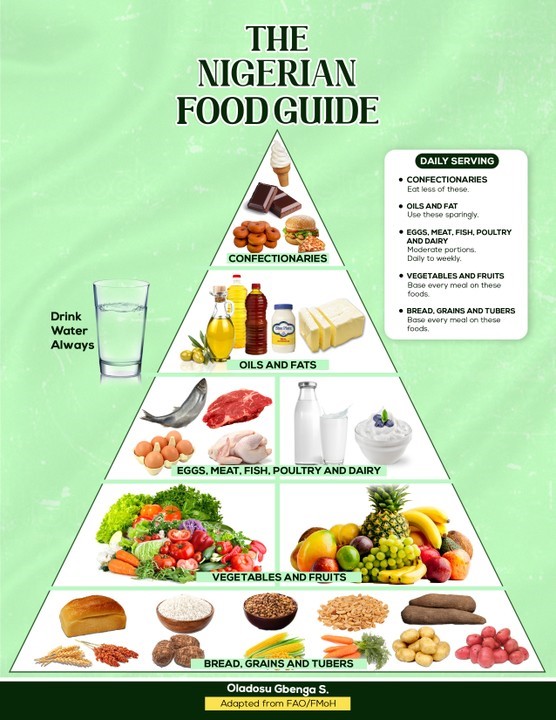
The food pyramid is presented in the form of a triangle and is a graphical representation of nutritional standards. It indicates the types and quantities of food needed daily to maintain the health status and prevent or reduce the risk of developing an eating disorder or nutritional diseases. The food pyramid is designed to make healthy eating easier. Healthy eating is about getting the right amount of nutrients – proteins, fats, carbohydrates, vitamins and minerals that is needed to maintain good health. There are different foods with different nutritional values, and it is not possible to get all the nutrients needed from a single food. Therefore, a variety of foods should be consumed from all food groups, as well as within each group, to obtain different nutrients and to meet the recommended nutrient intake per day. Over-eating or under-eating is not good for the health, there is a specific amount of nutrients needed every day to maintain optimum health. If food is not consumed in the right quantity, sub-nutrition and symptoms of various deficiencies may appear. When it is consumed in excess amount, it can lead to obesity and some cardiovascular diseases. Therefore, the right amount of food should be consumed to stay healthy.
The food pyramid is viewed from the base (beneficial foods that can be consumed in larger quantities) to the peak (foods that should be consumed with caution and in small quantities). Climbing each floor of the pyramid correlates with decreasing the amount of food, but it must be understood that no food is forbidden, but only recommended to eat it in moderation (portion control). The basic principle is balance.
In General, the Food Pyramid Comprises the Following 5 Food Groups, Namely
Bread, cereals, rice and pasta (6-11 servings per day).
Vegetables and fruits (3-5 servings per day);
Egg, fish, meat, poultry and dairy (2-3 servings per day);
Oil and fat (use sparingly).
Confectionaries (eat less of these)